Thursday, June 18, 2009

Georgetown, Panang Island, Malaysia

Georgetown is a UNESCO world cultural heritage city, and one can really see why. There are basically two cities here - Chinatown, Little India and the Colonial District is one city. Ugly high-rise development etc is built so separately it's like another city, and you never have to see it except from a distance.

Once upon a time the East India Company sailed in, took over the island with some false promises to the local sultan and didn't give it up for 300 years or so. Typical colonial story. They also brought in the Chinese and the Indians to "stimulate trade".

As a result, the best way to enjoy Georgetown is to just walk around and soak up the atmosphere. There are so many colonial buildings, Chinese temples, and Hindu temples here you don't need to go find them, they will find you.


Kuala Lumpur

KL was a lot nicer and cleaner than I remembered. I was here for the first time in 2000, and I think I have done so much travel since then my perspective has really changed. This time I saw it as a city you can enjoy yourself in - good food, easy to get around, everyone speaks English etc.

I really liked the Islamic-style buildings, in pastel colours and fanciful arches and spires. They look like light, airy castles.


The twin towers (Petronas Towers) were pretty cool too, although we missed out on going up to the connecting bridge.

Thursday, June 11, 2009

It's nice when things just work

Singapore was such a contrast to Indonesia, we were in culture shock. For the first day I was marvelling at the presence of:
- Sidewalks
- Pedestrian crossings
- Traffic lights
- Barriers separating people from holes you can fall into

The second day I was marvelling at:
- Efficient metro system (why can't we have one like that in Melbourne?)
- Amazing customer service
- Restaurant quality foodcourts (instead of the other way around in Indonesia)

The third day it was getting a bit too expensive, so we left for KL.

My take on Singapore is that it's a very livable city of you can take hot and sticky weather all the time. It's somewhat sanitised... you feel like if anything broke or went wrong it would be rectified within the hour. I mean, how can a city not have a single run-down looking building? And there are signs regarding "gracious behavior" and trains and other public spaces everywhere. I found them funny, but I must say I enjoyed the results :)

Monday, June 8, 2009

The rest of Indonesia

I thought I would be conscientious and finish my spiel about Indonesia. Unfortunately I can’t put up any of my own photos as my SD card has a virus on it or something… anyway I am sending it back home for my brother to fix. But I will download some for your viewing pleasure.

Java was our last island. We didn’t end up going to Sumatra as we simply ran out of visa time. I think anyone wanting to come here either needs to fly around (lots of people do as airfares are cheap) or come for 2 months as the barest minimum.

Java….
- Is by far the wealthiest and most developed island in the archipelago. Mercifully we were able to get off the buses and onto trains!
- Is mostly devoid of jungle, which has been cut down to make way for huge coffee and tea plantations and has lots and lots of people
- Practices a very mild form of Islam. Some women wear a headscarf, but not the majority from what I can see. No one actually seems to pray at prayer time. Everyone is busy trying to make money instead

The main sites in Java are the volcano of Gunung Bromo and the Buddhist temple of Borobudur.

Gunung Bromo is cool, but has been developed in the most hideous way. The standard thing to do is take a jeep up to the top at sunrise. So you think: “excellent, it will be nice, just me and the sun and a few other tourists marvelling at the power and magnificence of nature”. Wrong! After you park down the road from literally 50 or so other jeeps, you then brave your way through an avenue of tourists shops anxious to rent you a beanie, mitts, rain jackets etc (if it’s not stinking hot the Indonesians tend to think it’s freezing, in fact it’s milder than most mornings in Melbourne winter). Then you get to the viewing platform, which turns out to be an amphitheatre full of hundreds of people milling about, waiting for the sun and trying to avoid hawkers. This is the view we are meant to have seen:
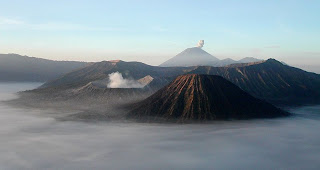


However what we saw was more obscured by mist & cloud than that. It’s still an impressive sight, but I just wish it didn’t have to be such a corny tourist experience.

We were more lucky with Borobudur as we went on a weekday and although there were other people there, you weren’t tripping over them. Very impressive temple:
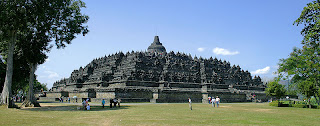


Unless you have a wide-lens camera you can’t actually take a photo like this, which encompasses the entire temple. It’s huge!

Jakarta was a shithole. Don’t go there.

Monday, June 1, 2009

Bali and Lombok

We have been through Bali and Lombok Islands in Indonesia. What to say without sounding negative – they can both boast of immense natural beauty, and in a way it was a big relief to get to a place where you can make yourself understood and are able to eat things are you familiar with. But I have to call it as I see it, and it’s no longer the tropical paradise it might have once been. In a way I think places like these can become victims of their own success. Tourists come, which provides commercial opportunities for the locals, which in turn makes the tourists happy as they have somewhere to stay and something to eat. But you can get too much of a good thing, and most of Bali has been massively overdeveloped. Don’t get me wrong, I enjoyed it, but it’s definitely not the chilled out sun beach and surf experience it once might have been. Would I come back? I think not, prefer to go back to Fiji.


This cultural side has been interesting though, Bali is the only Hindu island in Indonesia (Lombok, Sumatra and Java are Muslim, and Flores, Sumbawa and Timor are Christian). The architecture of the temples is impressive and reminds me a lot of what I saw in Nepal. Here is one temple that has been carved out of rock about a millennium or so ago:

Tuesday, May 19, 2009

Indonesia

We have been in Indonesia for nearly 2 weeks now, and I have to admit the travel has been pretty hard work. We’ve crossed the islands of West Timor, Flores and Sumbawa, using mainly local buses and ferries. On one hand it’s been interesting doing what the locals do, but on the other hand… sitting on a bus for 10 hrs a day with chickens, pigs, bags of rice, chain-smoking locals on all sides, and pressed 4 to a seat that is only meant to hold 2 is definitely an experience, but not a pleasant one. Plus the roads here are so windy and twisty through the mountainous terrain that our average traveling speed was slowed down to about 30km per hour (giving me plenty of time to consider exactly where and when my motion sickness will crystallize). Looking at the map I am actually amazed at how little distance we managed to cover in all this time, but it’s no good measuring distance in terms of kilometers here – only in terms of hours.

On the bright side, on those rare occasions we were released from our busage captivity, we had fun:

We visited traditional villages. The people in this one don’t have electricity or running water (although the “leader” does own a private generator), and they weave their own clothing from scratch. It takes them a week to finish a piece of embroidery (an ikat), which they try to sell to tourists for the princely sum of $2.50.


Climbed to the top of an active volcano:


(not this one, too hard :)


And best of all, saw Komodo dragons, the biggest lizards in the world! These animals give me the chills just like crocodiles do. They are pure predators, and have killed both locals and tourists (all they ever found left of a Swiss backpacker was his camera and sunglasses). The guides here don’t go anywhere without big long sticks, and seem to both admire and fear these animals equally. A full grown Komodo (the biggest are 3.5 meters) will take on anything – buffalo, deer, pig, human.

Saturday, May 9, 2009

East Timor

East Timor has all the makings of a tropical paradise – friendly locals, great beaches, diving and fresh and cheap seafood. It’s much more laid back and chilled out than many other parts of SE Asia. In development terms however it has a long way to go to even Indonesian Standards. This has positives and negatives – during our entire stay not a single kid asked me for money, there are no touts, traffic is very light. But infrastructure development outside of Dili is very basic, tourist services are pretty limited and English is not widely understood. So you really need to be prepared to be an intrepid traveler if you come here. And you really should come here, this is a country one can easily fall in love with.

In terms of safety, this is the first time I’ve been somewhere with such a large UN presence and it’s been interesting. It seems like you can’t take 10 steps without seeing an NGO or a UN office, and the UN vehicles are everywhere on the streets. I don’ think they actually do much anymore apart from drive around and be visible. But their very presence is very reassuring; it definitely creates an atmosphere of safety and security. In any case foreigners are not and have never been a target. One journalist I spoke to used to get right in the middle of fights to take pictures and all he ever got was “Hello Mister!”

Another side effect of the UN presence is the false economy it creates, where prices are about twice to three times what they are for a comparable product /service in Indonesia. Also after the Indonesians left the USD was adopted as official currency (to avoid inflation I assume), but this also doubled prices overnight. East Timor is not a cheap country to visit if you are not working and honestly I don’t know how people survive here is the average salary is $50 a month and a bottle of water costs 50 cents.

In terms of its colonial past, East Timor was never a jewel in the crown of the Portuguese empire, and so it lacks grandiose colonial architecture. Don’t expect anything like what the Spaniards built in Peru. But there are still interesting buildings around, and will be even more interesting once some money is found for their restoration. Many of them very used for Government purposes and were burned out by the departing Indonesians and the militia gangs.

There are plenty of signs of reconstruction, mostly in Dili. It seems like the government here is motivated and committed, and they need to be because there is certainly a lot to do here. The economy right now is very simple – foreign aid and subsistence agriculture. It is the poorest country in Asia by a wide margin. But the East Timorese do have some oil and gas fields that are currently being developed with Australia (who tried to cheat them out of it by the way and only relented under international pressure). Hopefully they will make the most of the revenue. Tourism needs to happen here if this country is to have a future.